
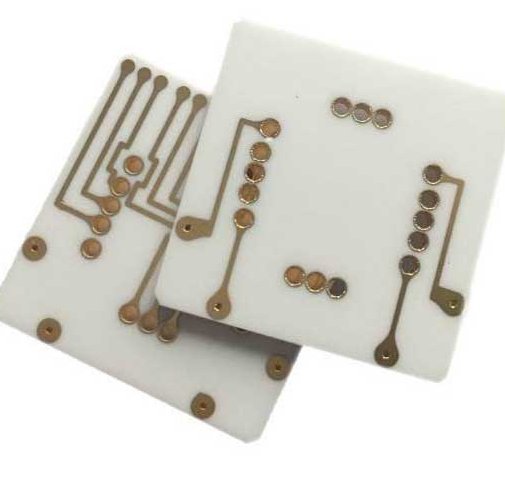
Define what “single-sided” includes
State whether the back face is bare ceramic, metallized for attachment or coated. A board with one electrical routing face can still have backside metal for heat transfer. This distinction affects flatness, stress, mounting and the thermal interface.
Select the circuit-forming route
Thick film supports printed functions; thin film supports precise deposited features; DPC offers plated patterns. Some power constructions use bonded copper. Choose the route from current, feature size, surface finish and assembly requirements rather than the number of circuit faces alone.
Review asymmetry and support
One-sided metallization can introduce a different curvature and stress state from a balanced double-sided structure. Confirm flatness requirements after metallization and assembly heating. Define pickup surfaces, support and the means of attachment to the cooler or housing.
Engineering example
A simple heater with terminals on one face may be electrically single-sided but need a controlled back surface for thermal contact. Include both faces in the mechanical specification.
Before you release the design
- Specify the back-face condition.
- State conductor material and finished thickness.
- Define attachment, flatness and handling requirements.
Sources and further technical reading
Manufacturer references support the material and process context. Worked examples and checklists are engineering guidance; they are not test results or supplier guarantees.